
Our Products
COW DUNG POWDER
COW DUNG POWDER
COW DUNG POWDER
COW DUNG POWDER
COW DUNG POWDER
COW DUNG POWDER
COW DUNG POWDER
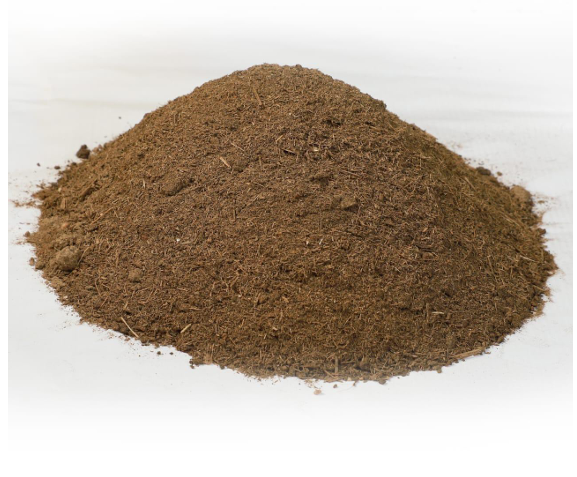
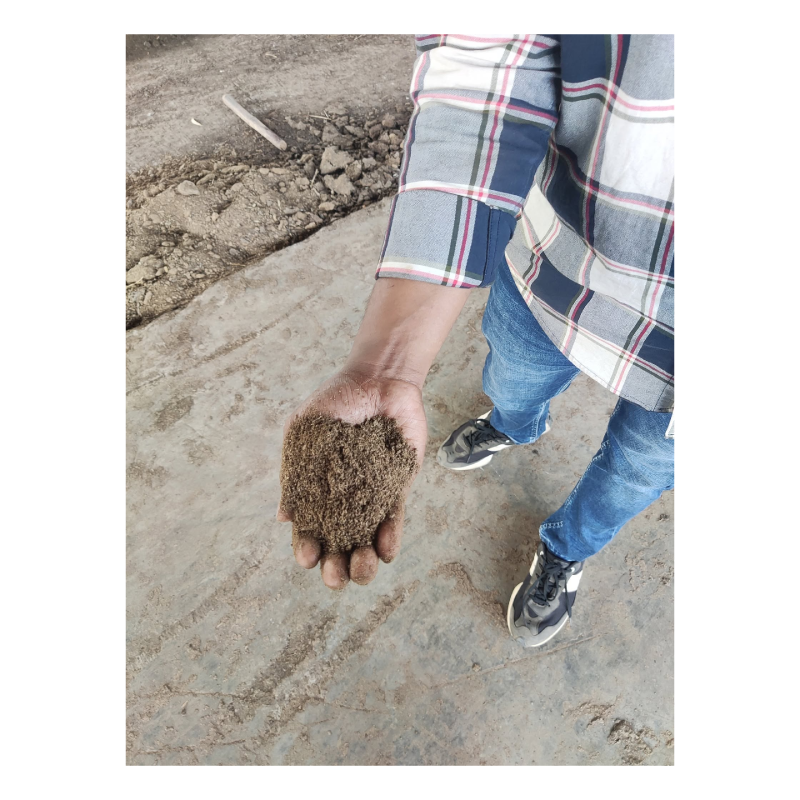
Organic Cow Dung Powder is a natural organic agricultural input produced from dried cow dung sourced from indigenous Indian cattle breeds, including Gir cattle, from registered farms in Maharashtra, India. The product is processed through natural sun drying, sieving, and grading. It is intended for use as an organic soil amendment and agricultural input for crop cultivation, horticulture, and sustainable farming applications.
Quality and safety assured — our Cow Dung Powder undergoes rigorous testing at an NABL-accredited lab, along with FMD-free certification from ICAR, Odisha, ensuring it meets international import and biosecurity standards.
Product Specifications
| Product Name | Organic Cow Dung Powder |
|---|---|
| Product Type | Natural Organic Agricultural Input / Organic Soil Amendment |
| Grades Available | Grade 14 | Grade 25 | Grade 40 |
| Physical Form | Powder / Granular |
| Appearance | Uniform powder to granular texture, free from visible foreign matter |
| Colour | Light Brown to Dark Brown (natural variation) |
| Odour | Natural earthy odour characteristic of dried organic matter |
| Raw Material Source | Cow dung sourced from indigenous Indian cattle (Bos indicus), including Gir cattle, from farms in Maharashtra, India |
| Animal Origin | Bovine (Bos indicus) – 100% bovine origin. |
| Processing Method | Natural sun drying, sieving, and grading. No chemicals, artificial heat, or additives are used. |
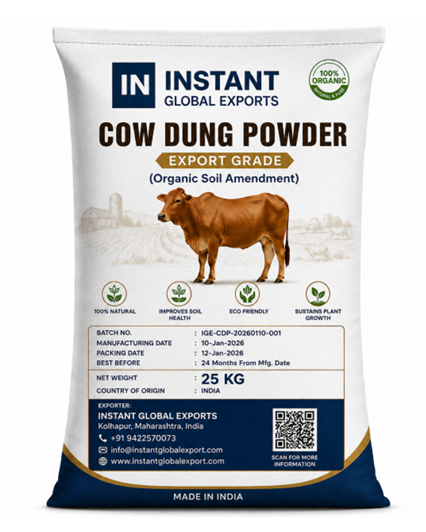
| Packaging Type | New HDPE or PP woven bags, sealed and labelled |
| Packaging Size | 25 kg (customisable as per buyer requirement) |
| Country of Origin | India |
| HS Code | 31010099 |
| Storage Condition | Store in a clean, dry, covered area away from moisture, direct sunlight, and chemicals |
| Intended Use | Agricultural, horticultural, and sustainable farming applications |
Grade Differentiation
All three grades contain identical raw material and composition. The grades differ only according to particle size, which is determined by the sieve mesh used during processing.
| Grade | Sieve Size (BSS) | Particle Size | Typical Use |
|---|---|---|---|
| Grade 14 | 5–10 Mesh | Coarse, approximately 2–4 mm | Direct soil application, compost blending, mulching, and landscaping |
| Grade 25 | 18–20 Mesh | Medium, approximately 0.8–1.0 mm | Nursery applications, potting mixtures, horticulture, and organic farming |
| Grade 40 | 40–60 Mesh | Fine, approximately 0.25–0.50 mm | Fine soil conditioning, seedling trays, premium potting media, incense stick (agarbatti) manufacturing, organic dhoop products, and other eco-friendly products requiring a fine powder |
The ingredient source, composition, country of origin, and processing method are identical across all three grades. This information covers Grade 14, Grade 25, and Grade 40 collectively.
Applications
| Application Area | Description |
|---|---|
| Soil Conditioning | Applied to agricultural land to improve soil structure, aeration, and water-holding capacity. It helps enrich organic matter content and supports healthier root development in crops. |
| Organic Farming | Used as a natural soil amendment in organic farming to supplement soil nutrition without synthetic inputs. Suitable for organic crop production systems. |
| Potting Mixtures | Blended with growing media such as coco peat, soil, or compost to prepare grow bags, seedling trays, and container mixtures for indoor and outdoor plant cultivation. |
| Nursery Applications | Used in plant nurseries for seedling germination beds, propagation trays, and plant bed preparation. It supports early-stage plant growth when blended with other growing media. |
| Horticulture | Suitable for fruit orchards, vegetable gardens, flower cultivation, and urban farming. It can be applied as a top dressing or incorporated into planting soil to support growing conditions. |
| Landscaping | Applied in lawn preparation, turf conditioning, public green spaces, and landscaping projects. It improves the organic content of sandy or nutrient-depleted soils. |
| Compost Blending | Blended with vermicompost, coco peat, green waste, or other organic materials to produce enriched compost or customised growing media for commercial or retail distribution. |
| Sustainable Agriculture | Supports regenerative and sustainable farming practices by returning natural organic matter to the soil. Suitable for farms seeking to reduce their dependence on synthetic fertilisers. |
| Traditional Eco-Friendly Product Manufacturing | Used as a natural base material in the production of traditional eco-friendly products, including natural flooring materials, decorative composts, and organic craft inputs. |
Processing Flowchart
The following process outlines the complete sequence from raw material collection to export dispatch.
Step 1 – Collection of Raw Material
Cow dung is collected from registered farms / Gaushalas in Maharashtra, India.
Step 2 – Pre-Cleaning & Foreign Material Removal
Visible debris, stones, and foreign materials are manually removed.
Step 3 – Natural Open-Air Sun Drying
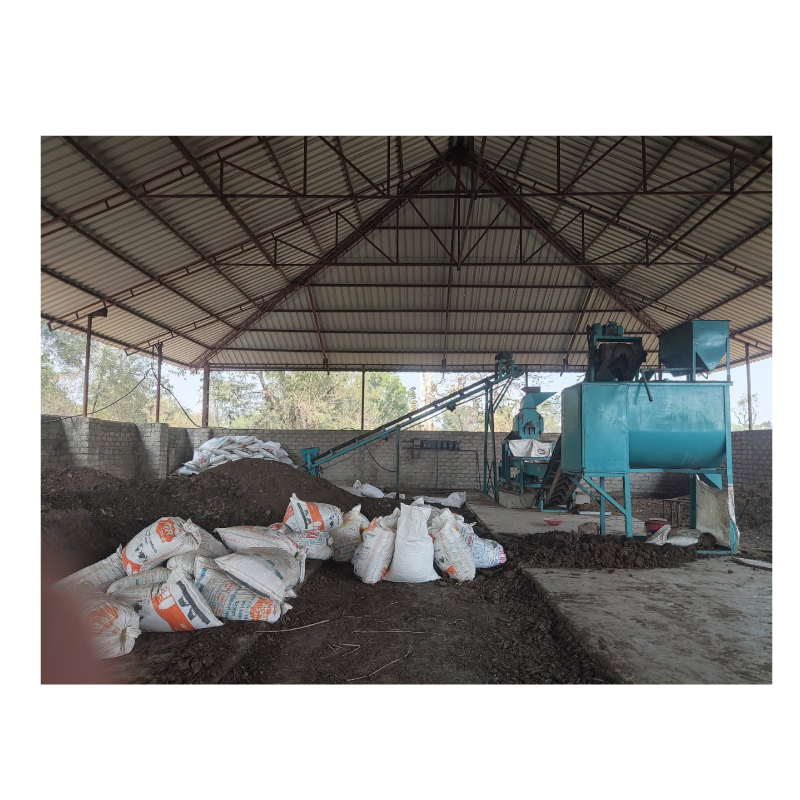
The material is spread on clean, raised platforms and dried using natural sunlight for approximately 3–7 days. It is manually turned every 24 hours to support even drying.
Step 4 – Moisture Check
The material is naturally dried to an acceptable moisture level before grading.
Step 5 – Sieving & Grading
The material is passed through sieving equipment and separated into Grade 14 (coarse), Grade 25 (medium), and Grade 40 (fine).
Step 6 – Quality Inspection
A visual inspection and quality check are conducted before packaging.
Step 7 – Packaging
The product is packed in HDPE or PP woven bags and labelled with the product name, grade, batch number, and country of origin.
Step 8 – Storage
The packaged product is stored in a clean, dry, and covered warehouse away from moisture and contaminants.
Step 9 – Export Dispatch
The product is dispatched with the required export documentation, including the packing list, commercial invoice, and Certificate of Origin.
All three grades follow the same processing sequence. The only variation is the sieve mesh size applied during Step 5.